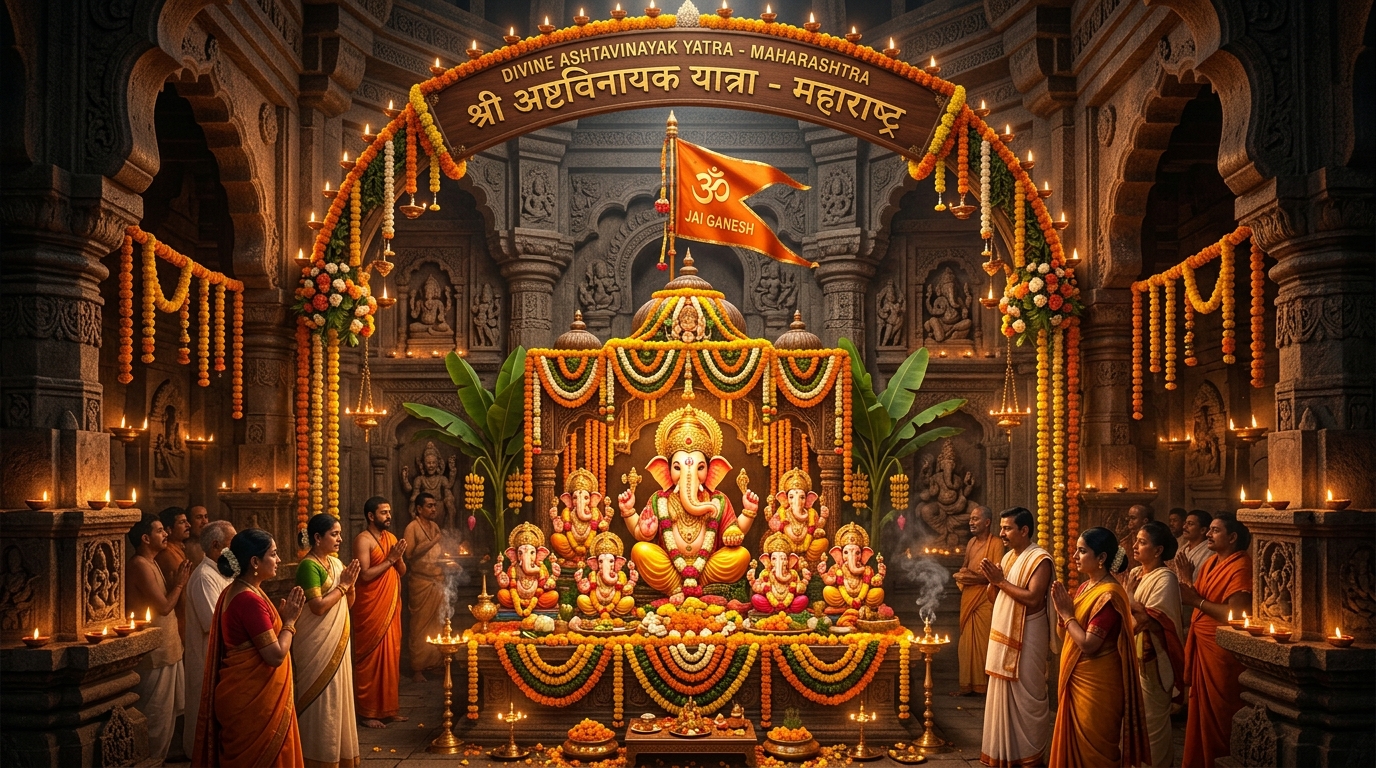
Which are the 8 Ashtavinayak Temples in Maharashtra: If you are planning the sacred Ashtavinayak Ganpati Darshan (अष्टविनायक दर्शन), the eight self-manifested (Swayambhu) shrines in canonical pilgrimage order are 1) Mayureshwar (Morgaon), 2) Siddhivinayak (Siddhatek), 3) Ballaleshwar (Pali), 4) Varadvinayak (Mahad), 5) Chintamani (Theur), 6) Girijatmaj (Lenyadri), 7) Vighneshwar (Ozar) and 8) Mahaganapati (Ranjangaon). Exactly 5 temples are located in Pune district, 2 in Raigad and 1 in Ahmednagar.
According to the Ganesha Purana, the sacred yatra must traditionally commence and conclude at Morgaon, completing a divine circumambulation of 650 to 700 km. Below is your complete, authoritative guide covering the 8 temples list and names, driving route map and tour itinerary from Pune and Mumbai, temple legends, Vidarbha Ashtavinayak and essential Aarti collection.
१. What is Ashtavinayak? The 8 Self-Manifested Shrines of Maharashtra (अष्टविनायक म्हणजे काय?)
The Ashtavinayak Yatra (अष्टविनायक यात्रा) is the most sacred and revered Ganesha pilgrimage on earth. The word Ashtavinayak is a Sanskrit compound formed from Ashta (अष्ट - Eight) and Vinayaka (विनायक - Supreme Remover of Obstacles). Unlike conventional idols sculpted by human hands, all eight idols in the Ashtavinayak circuit are Swayambhu (स्वयंभू) - naturally formed stone manifestations that emerged from the earth thousands of years ago.
Each of the eight shrines embodies a distinct incarnation, cosmic posture and legendary victory of Lord Ganesha, chronicled extensively in the sacred Ganesha Purana (गणेश पुराण) and Mudgala Purana (मुद्गल पुराण). Seven of these sacred temples reside in the scenic Pune and Raigad districts of Western Maharashtra, while one lies in Ahmednagar district.
In ancient Sanskrit etymology, the prefix 'Vi' (वि) denotes Vishesha (विशिष्ट - supreme, unique and extraordinary), while 'Nayaka' (नायक) signifies the supreme leader, protector and sovereign ruler. Hence, Vinayaka means "The Supreme Sovereign Leader of the Universe who has no master above Him."
While Lord Ganesha is affectionately worshipped as Ganpati and Bappa in Maharashtra, He is revered as Vinayaka in South India and classical Sanskrit Vedic literature.
The Sacred Rule of Ashtavinayak Yatra (प्रदक्षिणा नियम):
According to scriptural mandate, the Ashtavinayak pilgrimage is not complete by simply visiting the 8 temples at random. The yatra must strictly begin at Mayureshwar Temple in Morgaon, traverse through the remaining 7 shrines in their prescribed traditional sequence and finally conclude by returning to Morgaon for thanksgiving darshan. This complete circular circumambulation spans approximately 650 to 700 kilometers and symbolizes the sacred cosmic Pradakshina of Lord Ganesha around the universe.
The Sacred Ashtavinayak Smaran Shloka (स्मरण श्लोक):
Pilgrims and devotees traditionally chant this ancient Sanskrit verse from the Ganesha Purana before embarking on the holy yatra:
बल्लाळं मुरुडं विनायक महडं चिंतामणीं थेवरम् ॥
लेण्याद्रिं गिरिजात्मजं सुवरदं विघ्नेश्वरं ओझरम् ।
ग्रामे रांजण संस्थितं गणपतिं कुर्यात् सदा मंगलम् ॥
(Ganesha Purana - Sacred Ashtavinayak Smaran Shloka)
२. 8 Ashtavinayak Ganpati Temples List & Names (अष्टविनायक ८ गणपतींची नावे व संपूर्ण यादी)
Here is the complete reference list and structured chart of all eight holy shrines in their canonical pilgrimage order:
- १. श्री मयूरेश्वर - मोरगाव, पुणे (Shree Mayureshwar - Morgaon)
- २. श्री सिद्धिविनायक - सिद्धटेक, अहमदनगर (Shree Siddhivinayak - Siddhatek)
- ३. श्री बल्लाळेश्वर - पाली, रायगड (Shree Ballaleshwar - Pali)
- ४. श्री वरदविनायक - महड, रायगड (Shree Varadvinayak - Mahad)
- ५. श्री चिंतामणी - थेऊर, पुणे (Shree Chintamani - Theur)
- ६. श्री गिरिजात्मज - लेण्याद्री, पुणे (Shree Girijatmaj - Lenyadri)
- ७. श्री विघ्नेश्वर - ओझर, पुणे (Shree Vighneshwar - Ozar)
- ८. श्री महागणपती - रांजणगाव, पुणे (Shree Mahaganapati - Ranjangaon)
Note: As mandated by the Ganesha Purana, the sacred yatra completes only upon returning to Morgaon (#1) for final thanksgiving darshan.
| Order (क्रम) | Temple & Deity (मंदिर व नाव) | Location & District (गाव व जिल्हा) | Trunk & Posture (सोंड व दिशा) | Sacred Legend & Significance (पौराणिक कथा) |
|---|---|---|---|---|
| #1 | श्री मयूरेश्वर (मोरेश्वर)Shree Mayureshwar (Moreshwar) | मोरगाव (Morgaon)पुणे (Pune) | डावीकडे वळलेली सोंड (Left Trunk) | सिंधूरासुर राक्षसाचा वध करण्यासाठी मयूरावर स्वार झालेले रूप. यात्रेची सुरुवात व सांगता.Riding a celestial peacock to slay demon Sindhurasura. The start and end of Yatra. |
| #2 | श्री सिद्धिविनायकShree Siddhivinayak | सिद्धटेक (Siddhatek)अहमदनगर (Ahmednagar) | उजवीकडे वळलेली सोंड (Right Trunk - सिद्धपीठ) | भगवान विष्णूने मधू-कैटभ असुरांचा संहार करण्यापूर्वी येथे गणेशाची आराधना करून सिद्धी मिळवली.Lord Vishnu meditated here to attain Siddhi before vanquishing demons Madhu & Kaitabha. |
| #3 | श्री बल्लाळेश्वरShree Ballaleshwar | पाली (Pali)रायगड (Raigad) | डावीकडे वळलेली सोंड (पूर्वाभिमुख) | परम भक्त बाल बल्लाळाच्या भक्तीवर प्रसन्न होऊन गणेशाने भक्ताचे नाव धारण केलेले एकमेव मंदिर.The only Ganesha temple named after a devoted child disciple, Ballal. |
| #4 | श्री वरदविनायकShree Varadvinayak | महड (Mahad)रायगड (Raigad) | डावीकडे वळलेली सोंड (पूर्वाभिमुख) | गृत्समद ऋषींना वरदान देणारे वरदविनायक रूप. १८९२ पासून अखंड तेवणारा नंदादीप.Bestower of divine boons to Sage Gritsamada. Features an eternal lamp burning since 1892. |
| #5 | श्री चिंतामणीShree Chintamani | थेऊर (Theur)पुणे (Pune) | डावीकडे वळलेली सोंड (पूर्वाभिमुख) | कपिल ऋषींचे चिंतामणी रत्न गणू राजाकडून परत मिळवून दिले; भक्तांच्या सर्व चिंता हरणारे स्थान.Retrieved the wish-fulfilling Chintamani jewel for Sage Kapila, relieving all anxieties. |
| #6 | श्री गिरिजात्मजShree Girijatmaj | लेण्याद्री (Lenyadri)पुणे - जुन्नर (Pune - Junnar) | डावीकडे वळलेली सोंड (गुहेतील मूर्ती) | माता पार्वतीने (गिरिजा) पुत्रप्राप्तीसाठी १२ वर्षे तप केले. ३०७ पायऱ्यांवर वसलेली बौद्ध/हिंदू लेणी.Mountain cave where Goddess Parvati (Girija) meditated for 12 years to bear Ganesha as her son. |
| #7 | श्री विघ्नेश्वर (विघ्नहर)Shree Vighneshwar (Vighnahar) | ओझर (Ozar)पुणे - जुन्नर (Pune - Junnar) | डावीकडे वळलेली सोंड (सुवर्ण शिखर) | विघ्नासुर राक्षसाचा पराभव करून त्याला शरण आणले. मूर्तीच्या कपाळावर हिरा व डोळ्यात माणिक-पाचू.Subdued demon Vighnasura; adorned with ruby eyes, diamond forehead and golden spire. |
| #8 | श्री महागणपतीShree Mahaganapati | रांजणगाव (Ranjangaon)पुणे (Pune) | डावीकडे वळलेली सोंड (दशमुखी रूप) | भगवान शंकराने त्रिपुरासुर राक्षसाचा वध करण्यापूर्वी ज्या महाशक्तीची पूजा केली ते महागणपती रूप.Lord Shiva worshipped 10-trunked Mahaganapati here to receive power to destroy demon Tripurasura. |
३. 8 Ashtavinayak Temples History, Legends & Darshan Significance (८ मंदिरांचा इतिहास व दर्शन माहात्म्य)
१. श्री मयूरेश्वर गणपती - मोरगाव, पुणे (Shree Mayureshwar - Morgaon)
📍 Village: Morgaon, Taluka: Baramati, Dist: Pune | Distance from Pune: ~67 km
The Legend: According to the Ganesha Purana, in ancient Treta Yuga, a fierce demon named Sindhurasura (born from the wrath of the Sun God) terrorized the three realms. Sindhurasura was invulnerable to all weapons and bathed in red sindoor. Devotees prayed to Lord Ganesha, who manifested with six divine arms riding a celestial peacock (Mayura) given to Him by Lord Shiva and Goddess Parvati. Engaging Sindhurasura in a colossal duel, Lord Ganesha cleaved the demon in two and smeared His body with the demon's red lead, earning the divine name Mayureshwar (मयूरेश्वर / मोरेश्वर).
Temple Architecture & Uniqueness: The temple is built like a fortified medieval citadel with 50-foot-high black stone bastions (built by Bahmani rulers with four minarets so it resembled a mosque from afar to protect it from Mughal invaders). Uniquely, a majestic black stone Nandi (bull) sits directly facing Lord Ganesha in the courtyard - legend says the Nandi statue was being transported to a Shiva temple when the cart broke down at Morgaon and the Nandi refused to move!
२. श्री सिद्धिविनायक - सिद्धटेक, अहमदनगर (Shree Siddhivinayak - Siddhatek)
📍 Village: Siddhatek, Taluka: Karjat, Dist: Ahmednagar | Distance from Pune: ~98 km
The Legend: When Lord Brahma began cosmic creation, two dreadful demons, Madhu and Kaitabha, arose from Lord Vishnu's earwax and stole the Vedas, plunging creation into chaos. Lord Vishnu fought the demons for 5,000 years without victory. Perplexed, Lord Vishnu meditated upon Lord Shiva, who revealed: "You forgot to offer Prathama Puja to Ganesha before launching into battle!" Lord Vishnu then meditated atop the Siddhakshetra hillock on the banks of River Bhima, reciting the single-syllable Ganesha seed mantra (Om Gam Ganapataye Namah). Blessed with supreme divine Siddhi (cosmic power), Vishnu easily vanquished Madhu and Kaitabha.
Temple Architecture & Uniqueness: Situated majestically atop a hillock surrounded by Babul trees on the banks of the sacred Bhima River. The sanctum sanctorum was constructed by Punya-shloka Rajmata Ahilyabai Holkar. The idol is 3 feet high, facing north, with its trunk turned to the right (उजव्या सोंडेचा गणपती). Right-trunked Ganesha deities (Dakshinabhimukhi) are known to be extraordinarily powerful, demanding strict spiritual discipline and purity.
३. श्री बल्लाळेश्वर - पाली, रायगड (Shree Ballaleshwar - Pali)
📍 Village: Pali, Taluka: Sudhagad, Dist: Raigad | Distance from Pune: ~115 km, from Mumbai: ~110 km
The Legend: In the town of Pali, a young boy named Ballal was an ardent devotee of Lord Ganesha. He worshipped stone Ganesha idols in the forest with other village boys, spending hours in meditation. Angered by his son's neglect of commerce, his wealthy merchant father, Kalyan Sheth, rushed into the forest, thrashed young Ballal mercilessly, tied him to a tree, threw his sacred stone idol into the bushes and cursed him to starve. Bleeding and in agony, Ballal refused to curse his father and instead chanted Ganesha’s name continuously. Moved by the child's selfless devotion, Lord Ganesha manifested in the form of an ascetic Brahmin, instantly healed Ballal's wounds and embraced him.
When Ganesha offered Ballal a boon, the boy simply requested: "May You reside in this forest forever and may Your name be linked with mine." Lord Ganesha joyfully granted the wish, declaring: "Henceforth, I shall be known as Ballaleshwar (बल्लाळेश्वर - Ganesha who belongs to Ballal)!"
Temple Architecture & Uniqueness: This is the only temple in the world where Lord Ganesha is named after His devotee. Built in the shape of the Devanagari letter 'Shree' (श्री), the temple has two sacred water ponds (Tirtha). During the Dakshinayan period, the morning rays of the rising Sun fall directly on Lord Ganesha’s feet. A giant 500 kg Portuguese bronze bell, captured by Chimaji Appa after conquering Vasai Fort in 1739, hangs in the temple courtyard.
४. श्री वरदविनायक - महड, रायगड (Shree Varadvinayak - Mahad)
📍 Village: Mahad, Taluka: Khalapur, Dist: Raigad (near Khopoli) | Distance from Pune: ~90 km, from Mumbai: ~80 km
The Legend: Sage Gritsamada (a renowned Vedic seer of the Rigveda) was falsely cursed regarding his lineage. Despairing, he entered the dense Bhadraka forest (modern-day Mahad) and performed rigorous tapasya for centuries, reciting the Ganesha Mula Mantra. Pleased with his penance, Lord Ganesha appeared and granted him the boon of becoming the foremost Vedic sage and declared that this sacred forest would become Varada Kshetra - a divine sanctuary where every prayer is granted. Gritsamada consecrated Lord Ganesha here as Varadvinayak (वरदविनायक - The Bestower of Boons).
Temple Architecture & Uniqueness: Unlike other temples where devotees can only view the deity from outside, at Mahad, devotees are traditionally allowed to enter the inner sanctum (Gabhara) to touch the lotus feet of Lord Ganesha. The temple features a serene sacred lake (Peshwa Talav) filled with lotus flowers.
The Eternal Flame (अखंड नंदादीप): Inside the sanctum, an unbroken oil lamp (Nandadeep) has been continuously burning day and night without extinguishing since the year 1892 (over 134 continuous years), maintained with devotion by the temple priests.
५. श्री चिंतामणी - थेऊर, पुणे (Shree Chintamani - Theur)
📍 Village: Theur, Taluka: Haveli, Dist: Pune | Distance from Pune: ~26 km
The Legend: Sage Kapila possessed the celestial wish-fulfilling jewel called Chintamani (चिंतामणी), gifted to him by Goddess Lakshmi. When the arrogant Prince Gana (son of King Abhijit) visited the hermitage, Sage Kapila used the jewel to miraculously produce a royal feast for the prince's entire army. Overcome with greed, Prince Gana forcefully stole the Chintamani jewel. Sage Kapila prayed to Lord Ganesha, who fought Prince Gana under a divine Kadamba tree at Theur, destroyed the demon army and retrieved the jewel. When Kapila offered the jewel back to Lord Ganesha, Bappa tied the gem around His neck and agreed to stay at Theur to permanently eradicate all anxieties (Chinta) of His devotees.
Historic Peshwa Connection: Theur was the beloved spiritual sanctuary of Shrimant Madhavrao Peshwa I. Suffering from terminal illness, the great Maratha ruler spent his final days at Theur meditating on Chintamani Ganpati. Madhavrao passed away at Theur temple premises in 1772 and his devoted wife Ramabai performed Sati at the confluence of the Mula-Mutha rivers nearby, where a memorial still stands.
६. श्री गिरिजात्मज - लेण्याद्री, जुन्नर (Shree Girijatmaj - Lenyadri)
📍 Village: Lenyadri, Taluka: Junnar, Dist: Pune | Distance from Pune: ~96 km, from Mumbai: ~160 km
The Legend: Goddess Parvati, the daughter of the mountain king Himalaya (hence called Girija), deeply yearned to have Lord Ganesha as her own newborn son. She retreated to the secluded cliffside caves of Lenyadri and performed austere penance for 12 long years. On the auspicious day of Bhadrapada Shukla Chaturthi, Lord Ganesha materialized directly out of her clay idol as a radiant infant. Parvati lovingly named Him Girijatmaj (गिरिजात्मज - Girija + Atmaja = The Son of Mountain Daughter Parvati).
Cave Architecture & 307 Steps: Lenyadri is the only Ashtavinayak temple situated inside a natural mountain rock cave. Located in Cave No. 7 of a group of 30 ancient 1st-century Buddhist caves overlooking the Kukadi river, devotees must climb 307 stone steps up the cliff face. The cave consists of a gigantic prayer hall (Sabhamandap) carved out of solid rock, supported by zero pillars! The deity is an exquisite bas-relief carved directly onto the back rock wall of the cave.
७. श्री विघ्नेश्वर (विघ्नहर) - ओझर, जुन्नर (Shree Vighneshwar - Ozar)
📍 Village: Ozar, Taluka: Junnar, Dist: Pune | Distance from Pune: ~85 km (12 km from Lenyadri)
The Legend: King Abhinandana performed a massive yajna without inviting Indra, the king of gods. Furious, Indra created the monstrous demon Vighnasura (विघ्नासुर - The Demon of Obstacles) to destroy all Vedic rituals across the universe. Vighnasura wreaked havoc, killing sages and stopping sacred prayers. The gods prayed to Lord Ganesha, who engaged Vighnasura in battle and shattered his demonic pride. Falling at Ganesha's feet, Vighnasura surrendered completely and pleaded: "Please spare my life. I promise never to enter any place where Your name is chanted or Your holy Aarti is sung. Grant me the boon that my name will forever be remembered with Yours!" Lord Ganesha consented, becoming Vighneshwar / Vighnahar (विघ्नेश्वर - The Master & Destroyer of Obstacles).
Temple Architecture & Splendor: Built along the banks of the serene Kukadi river, the temple is renowned for its grand stone fortifications and an opulent pure gold spire (सुवर्ण शिखर) consecrated by Chimaji Appa after defeating the Portuguese. The idol faces East, with pure emerald (Pachu) stones embedded in its eyes and a glittering diamond on its forehead.
८. श्री महागणपती - रांजणगाव, पुणे (Shree Mahaganapati - Ranjangaon)
📍 Village: Ranjangaon, Taluka: Shirur, Dist: Pune (on Pune-Nagar Highway) | Distance from Pune: ~50 km
The Legend: Sage Gritsamada sneezed during meditation, producing a boy named Tripurasura. Blessed by Lord Brahma with three impregnable flying cities of gold, silver and iron (Tripura), the demon conquered heaven and earth, defeating Lord Shiva’s army. In despair, Lord Shiva consulted Sage Narada, who reminded Him: "Even the Supreme Shiva must invoke Lord Ganesha’s Mahaganapati form to destroy Tripura!" Lord Shiva meditated at Manipur (modern Ranjangaon) and chanted the Shadakshara Ganesha Mantra. Bestowed with cosmic arrows, Lord Shiva shot a single divine arrow that pierced and destroyed all three flying cities simultaneously, slaying Tripurasura.
Temple Architecture & The Hidden 10-Headed Idol: The temple was designed during the Peshwa era such that during the solar equinoxes, the morning sun rays fall directly on the idol. Behind the currently worshipped deity lies the ancient subterranean basement (Moykhana) containing the original esoteric Mahotkat form of Ganesha with 10 heads and 20 arms (दशमुखी व वीस हातांचे रूप), sealed away from public sight.
४. Ashtavinayak Route Map, Yatra & Tour from Pune / Mumbai (अष्टविनायक यात्रा नकाशा व दर्शन मार्ग)
Planning an Ashtavinayak tour from Pune or Mumbai requires optimal route management to avoid unnecessary backtracking while respecting the traditional pilgrimage spirit. Here is the complete driving route map and two time-tested itineraries:
Mumbai Pilgrims: You can join the circuit directly at Mahad (near Khopoli on Mumbai-Pune Expressway) or Pali, then proceed to Theur and Morgaon.
⚡ 2-Day Express Ashtavinayak Tour from Pune (जलद दर्शन यात्रा):
Designed for working professionals and pilgrims with limited time who wish to complete the full 8-temple circuit over a weekend:
Pune ➔ Theur ➔ Morgaon ➔ Siddhatek ➔ Ranjangaon (Night Stay: Ozar / Narayangaon)
- 05:30 AM: Depart early from Pune towards Theur (Shree Chintamani). (26 km, ~40 mins).
- 07:30 AM: Drive to Morgaon (Shree Mayureshwar). (55 km, ~1.5 hrs). Perform sacred Sankalp darshan.
- 11:30 AM: Drive to Siddhatek (Shree Siddhivinayak) via Daund. (65 km, ~2 hrs). Afternoon darshan by the Bhima river.
- 03:30 PM: Drive towards Ranjangaon (Shree Mahaganapati) on Pune-Nagar highway. (85 km, ~2.5 hrs).
- 07:30 PM: Proceed to Narayangaon or Ozar for overnight stay at Bhakta Niwas.
Ozar ➔ Lenyadri ➔ Mahad ➔ Pali ➔ Morgaon (Completion) ➔ Pune
- 06:00 AM: Morning darshan and Abhishek at Ozar (Shree Vighneshwar).
- 08:00 AM: Short drive to Lenyadri (Shree Girijatmaj). Climb 307 cave steps in the cool morning air.
- 11:00 AM: Drive down to Mahad (Shree Varadvinayak) near Khopoli via Malshej Ghat. (95 km, ~2.5 hrs).
- 02:30 PM: Drive to Pali (Shree Ballaleshwar). (40 km, ~1 hr).
- 05:30 PM: Drive back to Morgaon (Shree Mayureshwar) for the mandatory thanksgiving pradakshina completion.
- 09:30 PM: Return to Pune with divine blessings and prasad.
🗓️ Recommended 3-Day Relaxed Itinerary (Ideal for Families & Senior Citizens):
Pune ➔ Theur ➔ Morgaon ➔ Siddhatek (Night Stay: Daund/Pune/Siddhatek)
- 06:00 AM: Depart from Pune towards Theur (Shree Chintamani). (Distance: 26 km, ~45 mins). Attend morning Aarti.
- 08:30 AM: Drive towards Morgaon (Shree Mayureshwar). (Distance: ~55 km, 1.5 hrs). Complete the sacred start ritual (Sankalp).
- 12:30 PM: Enjoy traditional Maharashtrian lunch (Pithla Bhakri / Puran Poli) at Morgaon Bhakta Niwas.
- 02:30 PM: Drive to Siddhatek (Shree Siddhivinayak) via Daund. (Distance: ~65 km, 2 hrs). Complete riverbank Darshan and hill Pradakshina.
- 07:30 PM: Evening Aarti at Siddhatek and night stay nearby or proceed towards Ranjangaon.
Ranjangaon ➔ Ozar ➔ Lenyadri (Night Stay: Ozar / Junnar)
- 07:00 AM: Darshan at Ranjangaon (Shree Mahaganapati) on Pune-Nagar road.
- 10:00 AM: Drive towards Narayangaon to reach Ozar (Shree Vighneshwar). (Distance: ~80 km, 2 hrs).
- 01:00 PM: Lunch at Ozar riverside trust dining hall (Prasad).
- 03:30 PM: Short 12 km drive to Lenyadri (Shree Girijatmaj). Climb 307 steps before sunset for breathtaking cliffside views and cave Darshan.
- 07:30 PM: Return to Ozar for serene riverside evening Aarti and peaceful overnight stay at Bhakta Niwas.
Lenyadri ➔ Mahad ➔ Pali ➔ Morgaon (Completion) ➔ Pune / Mumbai
- 06:00 AM: Early descent via Malshej Ghat or expressway towards Mahad (Shree Varadvinayak) near Khopoli. (Distance: ~95 km, 2.5 hrs). Touch the deity's feet and witness the 1892 eternal flame.
- 10:30 AM: Scenic drive to Pali (Shree Ballaleshwar). (Distance: ~40 km, 1 hr). Ring the historic Vasai bell.
- 02:00 PM: Proceed back via Shirwal/Saswad road to Morgaon (Shree Mayureshwar) for the mandatory completion thanksgiving Darshan.
- 07:00 PM: Return to Pune or Mumbai with divine blessings, prasad and spiritual peace.
५. The Sacred Vidarbha Ashtavinayak: 8 Hidden Gems of Eastern Maharashtra (विदर्भातील अष्टविनायक)
While Western Maharashtra’s Ashtavinayak is globally famous, ancient scriptures also celebrate a profound and powerful regional cluster known as the Vidarbha Ashtavinayak (विदर्भातील अष्टविनायक). These 8 shrines across Nagpur, Wardha, Bhandara, Yavatmal and Chandrapur boast extraordinary mythological antiquity:
१. श्री टेकडी गणपती - नागपूर (Tekdi Ganpati, Nagpur)
One of Central India’s most visited temples. The Swayambhu idol naturally emerged from beneath an ancient Peepal tree and sits adjacent to Nagpur Railway Station.
२. श्री शामविघ्नेश - अदासा, सावनेर (Shamavighneshwar, Adasa)
Located atop a scenic hillock near Nagpur, featuring a monolithic 12-foot stone Ganesha carved out of single rock, worshipped since Treta Yuga.
३. श्री अष्टदशभुज गणपती - रामटेक (Ashtadashabhuja Ganpati, Ramtek)
A rare, breathtaking 18-armed Ganesha shrine situated on the legendary Ramtek hill where Lord Rama rested during His exile.
४. श्री मेंढा गणपती - भंडारा (Mendha Ganpati, Bhandara)
Nestled amidst tranquil forests and riverbeds in Bhandara district, revered for fulfilling agrarian wishes and community peace.
५. श्री पंचमुखी गणपती - पौनी, भंडारा (Panchamukhi Ganpati, Pauni)
Located on the banks of the holy Wainganga River in the ancient temple-town of Pauni (known as South Kashi), featuring a rare 5-faced Ganesha idol.
६. श्री सिद्धिविनायक - केळझर, वर्धा (Siddhivinayak, Keljhar)
Situated in historical Ekachakra Nagari from the Mahabharata, where Bhima slew the demon Bakasura. The ancient fort houses a self-manifested Ganesha.
७. श्री चिंतामणी - कळंब, यवतमाळ (Chintamani, Kalamb)
An extraordinary subterranean underground temple where Lord Ganesha sits in a deep pit (Khadda Ganpati). A natural holy freshwater spring (Ganesh Kunda) overflows every 12 years.
८. श्री भृशुंड गणपती - चंद्रपूर (Bhrushund Ganpati, Chandrapur)
Associated with Sage Bhrushundi (the legendary sage who was transformed into an elephant-headed yogi). Located near the Mahakali temple in historical Chandrapur.
६. Essential Aartis & Stotras for Ashtavinayak Yatra (यात्रा पूजा व आरती संग्रह)
Devotees traditionally recite sacred Aartis and Vedic Stotras at each temple sanctum. Singing these hymns in their authentic lyrical order invokes boundless divine grace:
७. Best Time to Visit, Temple Timings & Practical Pilgrim Tips (उपयुक्त माहिती व नियम)
🌤️ Best Season to Visit
October to March (Winter): Pleasant, cool weather across the Sahyadris, perfect for temple climbing and long drives.
July to September (Monsoon): Lush green landscapes, misty ghats and flowing waterfalls (especially near Pali, Mahad and Junnar).
⏰ Temple Timings & Abhishek
Most temples open between 05:00 AM and 05:30 AM and close after Shej Aarti at 10:00 PM.
Panchamrit Abhishek and Sahasranam Pooja are performed between 06:00 AM and 11:30 AM (booking at trust offices recommended).
👔 Dress Code
Modest traditional attire is strictly expected. For inner sanctum (Gabhara) Abhishek, men must wear a traditional silk/cotton Dhoti (सोवळे) with no shirt (Uttariya allowed) and women should wear traditional Sarees or modest Indian attire.
🏨 Accommodation & Food
All 8 temple trusts operate clean, highly affordable Bhakta Niwas (भक्त निवास) with AC and non-AC rooms (Ozar, Morgaon and Theur have exceptional facilities). Trust dining halls offer pure sattvic Mahaprasad for ₹30 to ₹60.
८. Frequently Asked Questions - Ashtavinayak Darshan FAQ (वारंवार विचारले जाणारे प्रश्न)
Essential answers to common queries about the 8 Ashtavinayak temples, darshan timings, route maps and traditional yatra rules:
Which are the 8 Ashtavinayak temples in Maharashtra (अष्टविनायकाची ८ मंदिरे कोणती)?
The 8 sacred Ashtavinayak Ganpati temples of Maharashtra are: 1) Shree Mayureshwar - Morgaon (Pune), 2) Shree Siddhivinayak - Siddhatek (Ahmednagar), 3) Shree Ballaleshwar - Pali (Raigad), 4) Shree Varadvinayak - Mahad (Raigad), 5) Shree Chintamani - Theur (Pune), 6) Shree Girijatmaj - Lenyadri (Pune), 7) Shree Vighneshwar - Ozar (Pune) and 8) Shree Mahaganapati - Ranjangaon (Pune). All 8 idols are Swayambhu (self-manifested).
How many Ashtavinayak temples are in Pune district (पुणे जिल्ह्यात किती अष्टविनायक आहेत)?
There are exactly 5 Ashtavinayak temples located in Pune district: Shree Mayureshwar (Morgaon), Shree Chintamani (Theur), Shree Girijatmaj (Lenyadri - Junnar), Shree Vighneshwar (Ozar - Junnar) and Shree Mahaganapati (Ranjangaon). The remaining 3 temples are situated in Raigad district (Ballaleshwar at Pali and Varadvinayak at Mahad) and Ahmednagar district (Siddhivinayak at Siddhatek).
What is the correct traditional sequence of Ashtavinayak Yatra (अष्टविनायक यात्रेचा योग्य क्रम कोणता)?
The authentic sequence according to Ganesha Purana is: 1) Mayureshwar (Morgaon), 2) Siddhivinayak (Siddhatek), 3) Ballaleshwar (Pali), 4) Varadvinayak (Mahad), 5) Chintamani (Theur), 6) Girijatmaj (Lenyadri), 7) Vighneshwar (Ozar), 8) Mahaganapati (Ranjangaon) and concluding back at Morgaon.
Why must the Ashtavinayak Yatra end at Morgaon (यात्रेची सांगता मोरगावलाच का करावी)?
According to sacred tradition, Morgaon is the prime spiritual centre (Moola Peetha) of the Ganesha universe. Completing the pilgrimage requires returning to Morgaon to offer thanksgiving, completing the divine cosmic circumambulation (Pradakshina).
How to plan an Ashtavinayak tour from Pune in 2 or 3 days (पुण्यावरून अष्टविनायक दर्शन कसे करावे)?
For a relaxed family pilgrimage, a 3-day itinerary is recommended: Day 1 covers Theur, Morgaon and Siddhatek; Day 2 covers Ranjangaon, Ozar and Lenyadri; Day 3 covers Mahad, Pali and return to Morgaon. For a faster pace, a 2-day express tour is possible by starting early at 5:00 AM from Pune.
What is the Ashtavinayak route map and total driving distance from Pune?
The standard Ashtavinayak driving route map from Pune spans approximately 650 to 700 km along the following circuit: Pune ➔ Theur (26 km) ➔ Morgaon (67 km) ➔ Siddhatek (98 km) ➔ Ranjangaon (85 km) ➔ Ozar (85 km) ➔ Lenyadri (12 km) ➔ Mahad (95 km) ➔ Pali (40 km) ➔ Morgaon (120 km) ➔ Pune (67 km).
Which Ashtavinayak temple has the trunk turned to the right (उजव्या सोंडेचा गणपती कोणता)?
Shree Siddhivinayak at Siddhatek (Ahmednagar district) is the only Ashtavinayak deity with the trunk turned to the right (Dakshinabhimukhi / Siddhi Peetha). The other seven deities feature trunks turned to the left.
What is the Vidarbha Ashtavinayak circuit (विदर्भातील अष्टविनायक काय आहेत)?
Along with the Western Maharashtra circuit, Vidarbha houses 8 revered Ganesha shrines: Tekdi Ganpati (Nagpur), Shamavighneshwar (Adasa), Ramtek, Mendha (Bhandara), Pauni, Keljhar (Wardha), Chintamani (Kalamb - underground pit) and Bhrushund Ganesh (Chandrapur).
What are the temple timings and dress code for Ashtavinayak temples?
Most temples open between 5:00 AM and 6:00 AM and close around 9:30 PM to 10:00 PM. Modest traditional attire (dhoti or kurta for men, saree or salwar for women) is recommended, especially for inner sanctum (Gabhara) Abhishek.