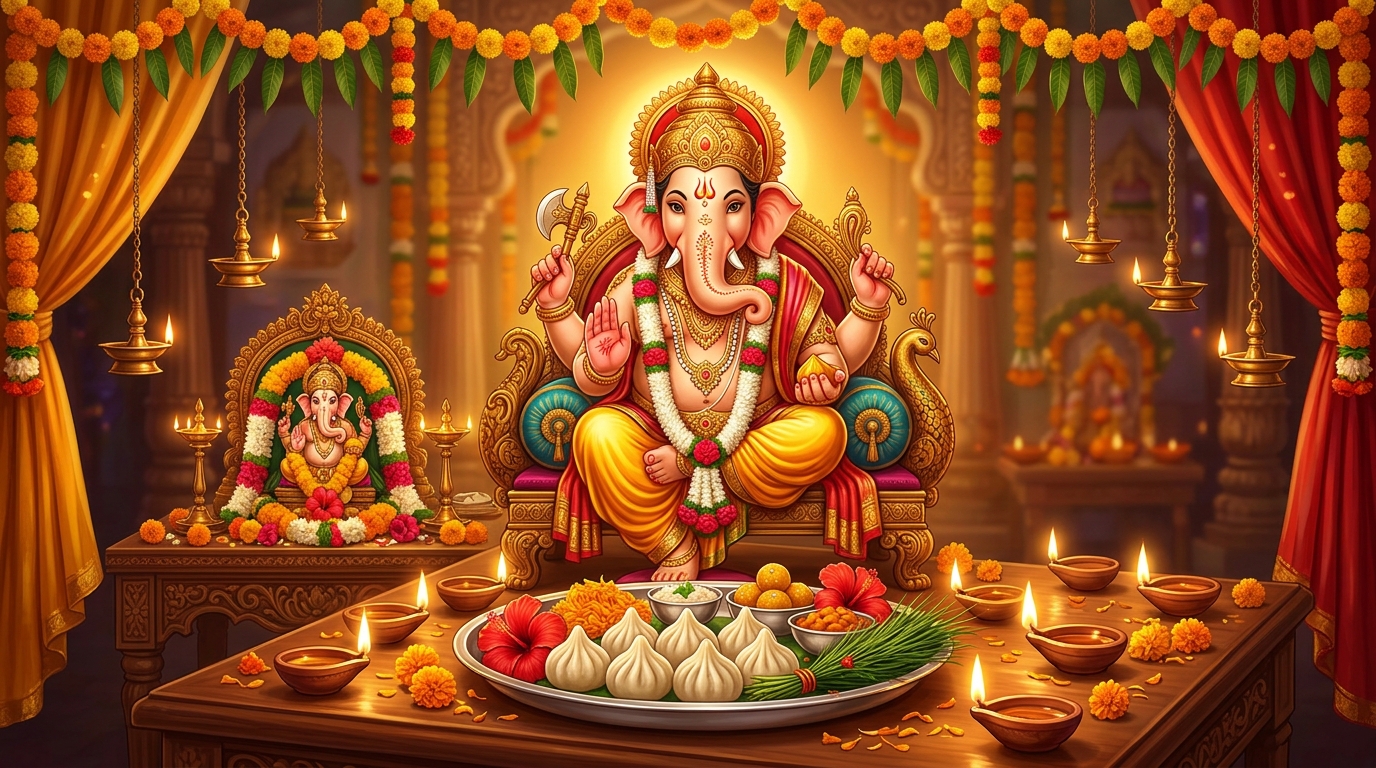
Ganesh Chaturthi 2026 Date in India: If you are wondering "when is Ganesh Chaturthi in 2026" or "2026 mein ganesh chaturthi kab hai", the sacred 10-day Hindu festival begins on Monday, September 14, 2026 (भाद्रपद शुक्ल चतुर्थी) and concludes on Friday, September 25, 2026 (अनंत चतुर्दशी विसर्जन).
According to authentic Vedic Panchang calculations, the auspicious Madhyahna Ganesha Puja Muhurat falls between 11:09 AM and 01:38 PM on September 14. Below is your complete, authoritative guide to the 2026 festival calendar, Shubh Muhurat timings, Jyeshtha Gauri pujan dates, step-by-step Sthapana vidhi and essential Aarti lyrics.
१. Ganesh Chaturthi 2026 Vedic Panchang Timetable (गणेशोत्सव पंचांग व संपूर्ण वेळापत्रक)
The divine festival of Ganesh Chaturthi (गणेश चतुर्थी), also reverently called Vinayaka Chaturthi or Ganeshotsav, will begin on Monday, September 14, 2026. Falling in the sacred Hindu month of Bhadrapada (भाद्रपद शुक्ल चतुर्थी), this 10-day extravaganza fills homes and pandals across Maharashtra, India and the global diaspora with spiritual fervour.
According to the authentic Vedic Panchang (प्रामाणिक वैदिक पंचांग), here is the complete day-by-day timetable including Haritalika, Gauri Agaman, Pujan, Visarjan and Anant Chaturdashi:
| Date & Day (तारीख) | Tithi (तिथी) | Sacred Event (सण व उत्सव) | Significance & Rituals (महत्त्व) |
|---|---|---|---|
| 14 Sep 2026Monday (सोमवार) | भाद्रपद शु. ३/४ | 🌸 हरितालिका तृतीया & 🐘 श्रीगणेश चतुर्थी🌸 Haritalika Tritiya & 🐘 Ganesh Chaturthi | पार्थिव श्रीगणेश स्थापना व पूजन. चंद्रदर्शन निषेध (चंद्रास्त रात्री ०८:४४ पर्यंत). |
| 15 Sep 2026Tuesday (मंगळवार) | भाद्रपद शु. ४/५ | 🌿 ऋषिपंचमी🌿 Rishi Panchami | सप्तर्षी पूजन, कंदमुळे भक्षण व्रत. श्री संत गजानन महाराज पुण्यतिथी (शेगाव). |
| 17 Sep 2026Thursday (गुरुवार) | भाद्रपद शु. ६ | 👑 ज्येष्ठागौरी आवाहन👑 Jyeshtha Gauri Avahan | अनुराधा नक्षत्रावर गौरी आवाहन (सायं. ०७:५२ पर्यंत). माहेरवाशीण म्हणून गौरीचे आगमन. |
| 18 Sep 2026Friday (शुक्रवार) | भाद्रपद शु. ७ | 🌸 ज्येष्ठागौरी पूजन (गौरी भोजन)🌸 Jyeshtha Gauri Pujan | पारंपरिक १६ भाज्या, पुरणपोळी व खीरीचा महालक्ष्मी महा-नैवेद्य व हळदीकुंकू. |
| 19 Sep 2026Saturday (शनिवार) | भाद्रपद शु. ८ | 🌊 ज्येष्ठागौरी विसर्जन🌊 Jyeshtha Gauri Visarjan | मूळ नक्षत्रावर ज्येष्ठागौरी विसर्जन, दुर्गाष्टमी व दोरक धारण. |
| 25 Sep 2026Friday (शुक्रवार) | भाद्रपद शु. १४ | 🚩 अनंत चतुर्दशी (गणेश विसर्जन)🚩 Anant Chaturdashi (Ganesh Visarjan) | १० दिवसांच्या मंगलमय गणेशोत्सवाची सांगता. वाजतगाजत बाप्पांचे विसर्जन. |
| 29 Sep 2026Tuesday (मंगळवार) | भाद्रपद कृ. ४ | 🔴 अंगारक संकष्ट चतुर्थी🔴 Angarak Sankashti Chaturthi | मंगळवारी येणारी दुर्मिळ व संकटहारक संकष्टी चतुर्थी. चंद्रोदय रात्री ०८:१४ वाजता. |
२. Shubh Puja Muhurat & Moon Sighting Caution (मध्यान्ह पूजा मुहूर्त)
Unlike most Hindu pujas performed at dawn, Lord Ganesha's Sthapana and Puja are performed during the Madhyahna Kaal (मध्यान्ह काळ - noon period), which is believed to be the exact time of Lord Ganesha’s divine emergence.
- Puja Timing: 11:09 AM to 01:38 PM (Monday, September 14, 2026)
- Total Duration: 2 Hours and 29 Minutes
- Chaturthi Tithi Begins: September 14, 2026 at 02:44 AM
- Chaturthi Tithi Ends: September 15, 2026 at 04:30 AM
🚫 Moon Sighting Caution (चंद्रदर्शन निषेध):
According to the Ganesha Purana and authentic Kalnirnay panchang, gazing at the Moon on Bhadrapada Shukla Chaturthi invites Mithya Kalank (मिथ्या कलंक) - unjust accusations and loss of reputation. On September 14, 2026, devotees must strictly avoid looking at the moon until moonset at 08:44 PM (चंद्रास्त रात्री ०८:४४). If the moon is sighted accidentally, chanting the sacred Syamantaka Mani Mantra removes all planetary flaws:
सुकुमारक मा रोदीस्तव ह्येष स्यमन्तकः ॥
३. Why is Ganesh Chaturthi Celebrated? (गणेश चतुर्थी का साजरी केली जाते? - जन्मकथा व ऐतिहासिक महत्त्व)
One of the most frequent questions asked by devotees across the globe is: why is Ganesh Chaturthi celebrated (गणेशोत्सव का साजरा केला जातो)? The answer lies at the intersection of timeless Hindu mythology, Vedic spiritual science and India's patriotic independence movement.
🕉️ The Divine Birth of Lord Ganesha (श्रीगणेश जन्मोत्सव कथा)
According to the sacred Shiva Purana and Ganesha Purana, Goddess Parvati fashioned a radiant boy from the natural sandalwood paste (उटणे/चंदन) of Her own body and breathed life (Prana Pratishtha) into Him. She posted Him as guard while She bathed, commanding Him to let no one enter.
When Lord Shiva arrived, the young boy dutifully stopped the supreme deity. In the ensuing confrontation, Shiva severed the boy's head. Seeing Mother Parvati's cosmic sorrow and fierce fury, Lord Shiva commanded the celestial attendants (Ganas) to bring the head of the first living creature found sleeping facing North. They returned with the head of an auspicious elephant. Lord Shiva joined the elephant head to the boy's body, revived Him and named Him Ganesha (ईश of Ganas) or Ganapati.
Shiva also bestowed upon Him the supreme divine boon: Ganesha would be Prathama Pujya (प्रथम पूज्य) - worshipped first before any god, ritual, yajna or new venture in all three worlds. This divine advent took place on Bhadrapada Shukla Chaturthi, which is why millions of families celebrate this holy day as Ganesh Chaturthi.
Beyond religious veneration, Ganesh Chaturthi holds profound socio-political importance in modern Indian history. In 1893, national leader Lokmanya Bal Gangadhar Tilak transformed Ganeshotsav from private household sanctums into a vibrant, public community festival (Sarvajanik Ganeshotsav). Tilak utilized the festival to bring Indians of all communities together, circumventing the British colonial ban on public gatherings and laying the groundwork for India's freedom movement.
४. Ganesh Chaturthi in January vs September: Tilkund Chaturthi vs Bhadrapada Ganeshotsav (जानेवारी की सप्टेंबर?)
Many devotees searching the calendar ask: "Is Ganesh Chaturthi celebrated in January 2026 or September 2026?" (जानेवारी २०२६ मध्ये गणेश चतुर्थी कधी आहे?). There is often widespread confusion between two major Ganesha festivals observed in Maharashtra and throughout India:
| Festival Aspect | January: Maghi Ganesh Jayanti (माघी गणेशोत्सव) | September: Bhadrapada Ganeshotsav (भाद्रपद गणेशोत्सव) |
|---|---|---|
| Hindu Month & Tithi | Magha Shukla Chaturthi (माघ शुक्ल चतुर्थी / तिलकुंद चतुर्थी) | Bhadrapada Shukla Chaturthi (भाद्रपद शुक्ल चतुर्थी) |
| 2026 Gregorian Date | Friday, January 23, 2026 | Monday, September 14, 2026 |
| Significance | Lord Ganesha's celestial manifestation day (Ganesh Jayanti). Devotees offer special white sesame (तीळ) modaks. | Grand 10-day public festival commemorating Parthiva Ganesha sthapana, Jyeshtha Gauri pujan and Visarjan. |
| Nature of Celebration | Deeply observed in Ganesha temples across Konkan, Pune (Sarasbaug) and Ashtavinayak shrines. Mostly 1-day fast and Abhishek. | Massive 10-day socio-cultural carnival with domestic clay idols, community pandals, Dhol-Tasha pathaks and immersion processions. |
| Which is the Main 10-Day Festival? | One-day temple observance (तिलकुंद / माघी गणेश) | The Primary Worldwide 10-Day Ganeshotsav |
Therefore, while Ganesh Jayanti (Tilkund Chaturthi) took place on Friday, January 23, 2026, the world-famous 10-day Ganesh Chaturthi festival 2026 begins on Monday, September 14, 2026.
५. Why Ganesh Chaturthi Date Changes Every Year (तिथी व पंचांग गणना)
Many devotees wonder why Ganesh Chaturthi does not occur on a fixed Gregorian date each year like New Year or Christmas. The Hindu calendar follows a Luni-Solar Panchang (चांद्र-सौर पंचांग) based on the precise phases of the Moon (Tithi) rather than solar 365-day cycles.
Ganesh Chaturthi is strictly observed on the 4th lunar day of the waxing moon (शुक्ल पक्ष चतुर्थी) in the month of Bhadrapada. Because the lunar year is roughly 354 days (about 11 days shorter than the solar year), the date shifts across late August and September each year, realigned periodically through the leap month (Adhik Maas).
६. Jyeshtha Gauri Agaman, Pujan & Visarjan 2026 (महाराष्ट्रातील ज्येष्ठागौरी उत्सव)
In Maharashtra and surrounding regions, the arrival of Jyeshtha Gauri (ज्येष्ठागौरी) is celebrated with profound joy and devotion as the arrival of Goddess Parvati (Gauri) visiting her maternal home (माहेरवाशीण) to meet her beloved son Ganesha.
🌸 गौरी आवाहन (Gauri Avahan)
गुरुवार, १७ सप्टेंबर २०२६
Gauri is welcomed under Anuradha Nakshatra (सायं. ०७:५२ पर्यंत / till 07:52 PM). Women imprint auspicious lotus footprints with kumkum leading from the entrance to the puja altar with chants of "गौरी आली, सोन्याच्या पावलांनी आली!"
👑 महालक्ष्मी पूजन व नैवेद्य (Gauri Pujan)
शुक्रवार, १८ सप्टेंबर २०२६
The grand feast day! Devotees offer a traditional lavish Mahanaivedya consisting of 16 different wild & seasonal vegetables (१६ भाज्या), traditional Puran Poli, Kheer and savoury delicacies, followed by Haldi-Kumkum.
🌊 गौरी विसर्जन (Gauri Visarjan)
शनिवार, १९ सप्टेंबर २०२६
Under Mool Nakshatra, a heartfelt farewell Aarti is performed with offerings of curd-rice (दही-भात) and soaked fenugreek seeds, bidding farewell until next year.
७. Deep History & Cultural Evolution of Ganeshotsav (गणेशोत्सवाचा प्राचीन ते आधुनिक इतिहास)
The story of Ganeshotsav is not just a tale of religious worship - it is a breathtaking journey spanning thousands of years, weaving through sacred Vedic scriptures, medieval royal patronage under Chhatrapati Shivaji Maharaj, the lavish celebrations of the Peshwas and a revolutionary patriotic awakening ignited by Lokmanya Bal Gangadhar Tilak in 1893.
७.१ Vedic & Puranic Origins (पौराणिक व वैदिक उगम)
Veneration of Lord Ganesha is deeply rooted in the ancient Rigveda, where He is invoked as the supreme leader of cosmic energies (Ganadhyaksha):
ज्येष्ठराजं ब्रह्मणां ब्रह्मणस्पत आ नः शृण्वन्नूतिभिः सीद सादनम् ॥
(Rigveda Mandala 2, Sukta 23, Verse 1)
According to the Ganesha Purana and Mudgala Purana, Goddess Parvati created Ganesha from natural turmeric and sandalwood paste, infusing life into Him on the sacred day of Bhadrapada Shukla Chaturthi. When Lord Shiva granted Him the divine boon of Prathama Pujya (प्रथम पूज्य), it was decreed that no ritual, sacred yajna, new enterprise or prayer across the three realms could begin without first seeking Ganesha’s blessings.
In the Mahabharata, Sage Vedavyasa requested Lord Ganesha to scribe the epic. Ganesha agreed on one continuous condition - that Vyasa must recite without pause. When Ganesha's celestial pen snapped under the speed of composition, Bappa broke off His own right tusk (becoming Ekadanta) to continue writing without interrupting the sacred knowledge.
७.२ The Maratha Era: Chhatrapati Shivaji Maharaj & The Peshwas (शिवकालीन व पेशवेकालीन वैभव)
Before the 17th century, Ganesha worship was largely confined to household sanctums. During the rise of the Maratha Empire, Chhatrapati Shivaji Maharaj recognized the divine power of Lord Ganesha to instill courage, moral righteousness and unity among the people of Maharashtra.
Shivaji Maharaj and His revered mother, Rajmata Jijabai, established the historical Kasba Ganpati temple in Pune around 1636, honouring Ganesha as the supreme Gramdaivat (guardian deity) of the city. Grand public celebrations were held at Pune and Fort Rajgad to invoke victory and divine protection against oppressive foreign invaders.
In the 18th century, the Peshwas of Pune (especially Shrimant Madhavrao Peshwa and Nana Fadnavis) elevated Ganeshotsav to an opulent state festival. At the grand Shaniwar Wada palace, a majestic 10-day celebration was organized with classical Dhrupad concerts, Marathi Kirtans, poetry recitals and massive community feasts feeding thousands of citizens regardless of wealth.
७.३ 1893: Lokmanya Tilak & The Sarvajanik Ganeshotsav Revolution (लोकमान्य टिळक व स्वातंत्र्य लढा)
Following the fall of the Maratha Empire in 1818, the festival receded back into private homes under British colonial rule. However, in 1893, the festival underwent a revolutionary transformation that changed the course of Indian history.
In the late 19th century, the British colonial government enforced strict anti-sedition laws and Section 144, banning public gatherings of more than 5 Indian citizens to prevent political discourse and resistance.
- The Genius Strategy: Lokmanya Bal Gangadhar Tilak realized the British administration had pledged non-interference in native religious practices. Tilak brilliantly transformed domestic Ganesha pooja into Sarvajanik Ganeshotsav (सार्वजनिक गणेशोत्सव).
- Breaking Caste & Social Barriers: Public pandals were established where Brahmins, farmers, artisans and labourers sat side by side, singing Aartis and breaking rigid social divisions.
- The Stage for National Awakening: Pandals at Kesari Wada and Vinchurkar Wada in Pune became vibrant hubs for patriotic lectures, freedom poetry, folk theatre (Mela songs) and strategic planning for India's independence.
- National Leaders Gathered: Great freedom fighters including Subhash Chandra Bose, Mahatma Gandhi and Lala Lajpat Rai visited public Ganeshotsav mandals in Pune and Mumbai to address surging crowds.
७.४ The 5 Historic 'Manache Ganpati' of Pune (पुण्यातील ५ मानाचे गणपती)
१. श्री कसबा गणपती (Shree Kasba Ganpati) - मानाचा पहिला गणपती
The presiding Gramdaivat of Pune, installed by Rajmata Jijabai Bhosale in 1636. Leads all immersion processions with pure Vedic tradition.
२. श्री तांबडी जोगेश्वरी गणपती (Shree Tambdi Jogeshwari Ganpati) - मानाचा दुसरा गणपती
Temple of Goddess Jogeshwari (Gramdevi of Pune). The brass palanquin procession is famous for retaining traditional Dhol-Tasha and silver chariot traditions.
३. श्री गुरुजी तालीम गणपती (Shree Guruji Talim Ganpati) - मानाचा तिसरा गणपती
Established in 1887 by wrestling masters Shinde and Nalband before Tilak’s public movement, standing as a timeless beacon of Hindu-Muslim communal brotherhood.
४. श्री तुळशीबाग गणपती (Shree Tulshibaug Ganpati) - मानाचा चौथा गणपती
Famous for installing Pune's first massive glass-fiber idol standing 13 feet high, adorned with breathtaking silver and gold ornaments.
५. श्री केसरी वाडा गणपती (Shree Kesari Wada Ganpati) - मानाचा पाचवा गणपती
Installed by Lokmanya Tilak himself at Kesari Wada in 1894, continuing the legacy of patriotic discourses and social welfare.
७.५ The Mumbai Splendor & Lalbaugcha Raja (मुंबईचा गणेशोत्सव व लालबागचा राजा)
In Mumbai, the festival grew into the world’s largest open-air socio-cultural celebration. In 1934, local Koli fishermen and vendors in Lalbaug faced the closure of the Peru Chawl marketplace. They took a sacred vow (Navas) to Lord Ganesha, praying for a permanent marketplace. When their wish was granted, they founded Lalbaugcha Raja (लालबागचा राजा - नवसाचा गणपती).
Today, millions of devotees from every corner of India, celebrities and world travellers stand in the legendary Mukh Darshan and Navas (Charan Sparsh) queues for over 24 to 40 hours just to touch the feet of the King of Lalbaug.
७.६ Spiritual Anatomy: The Esoteric Meaning of Ganesha’s Form (गजाननाचे गूढ तत्त्वज्ञान)
🐘 Big Head (विशाल मस्तक)
Symbolizes broad visionary thinking, immense wisdom and boundless intellectual capacity.
👂 Large Ears (मोठे कान)
Listen more, absorb wisdom and filter out negative gossip like a traditional grain winnowing basket (सूप).
👁️ Small Focused Eyes (बारीक डोळे)
Represents deep spiritual concentration, sharp foresight and looking beyond external illusions (Maya).
🦷 Single Broken Tusk (एकदंत)
Retain good wisdom, discard the harmful. Symbolizes willingness to make supreme personal sacrifice for truth.
🪔 Large Belly (लंबोदर)
The capacity to digest all pleasant and unpleasant experiences of life peacefully without losing equanimity.
🐀 Little Mouse (मूषक वाहन)
The restless mind and worldly desires (symbolized by a rodent) must be kept strictly disciplined under the guidance of intellect.
८. Eco-Friendly Clay Ganesha (शाडूची माती व पर्यावरणपूरक उत्सव)
Vedic scriptures specifically prescribe worshipping a Parthiva Ganesha (पार्थिव गणेश) - an idol crafted from natural earth or clay (Shadu Mati / शाडूची माती). Clay idols dissolve completely in water within a few hours, returning harmlessly to Mother Earth.
- Scriptural Authenticity: Mud and clay retain natural spiritual sattvic vibrations.
- Protects Water Bodies: Avoids toxic chemical paints and non-biodegradable Plaster of Paris (PoP).
- Home Visarjan (घरगुती विसर्जन): Clay idols can be immersed peacefully at home in a bucket or garden pot and the sacred mud can nourish a home plant (Tree Ganesha).
९. Dos and Don'ts for 10-Day Ganeshotsav (काय करावे आणि काय टाळावे)
✅ काय करावे (DOs)
- Perform morning and evening Aarti regularly with a pure heart.
- Offer fresh green Durva grass in odd counts (21 blades).
- Keep the puja area clean, illuminated with a continuous diya (अखंड दिवा).
- Maintain a sattvic, peaceful and joyful atmosphere at home.
❌ काय टाळावे (DON'Ts)
- Do NOT look at the Moon on Chaturthi evening (till 08:44 PM / चंद्रास्त वेळ).
- Never offer Tulsi (तुळस) leaves to Lord Ganesha (prohibited in scriptures).
- Do not leave the Ganesha idol completely alone without family presence.
- Avoid stale or leftover food in Naivedya.
१०. The Secret of 21 Modaks & Durva Offering (मोदक व २१ दुर्वांचे रहस्य)
Why does Lord Ganesha love Ukadiche Modak (उकडीचे मोदक) and Durva (दूर्वा) above all jewels and riches?
According to ancient legend, when Lord Ganesha swallowed the fierce demon Analasura (the fire demon), immense heat engulfed Bappa's stomach. Sages and gods offered cool celestial herbs, but nothing pacified the burning until Sage Kashyapa offered 21 blades of cooling Durva grass. The moment Ganesha consumed the Durva, the internal heat subsided. Hence, 21 Durva blades remain the dearest offering to Bappa.
The Modak represents supreme spiritual knowledge (Brahma-Vidya). Just as the outer shell of a modak is simple and white, but conceals a divine, sweet coconut-jaggery core inside, spiritual realization brings divine inner bliss beyond outer material illusions.
११. Step-by-Step Ganesha Sthapana & Puja Vidhi (गणपती स्थापना व सोपी पूजा विधी)
You do not need complicated rituals to invite Lord Ganesha into your home. A pure heart, devotion and following these 5 simple steps will bless your home with prosperity:
चौरंग स्थापना व कलश पूजन (Altar Preparation & Kalash)
Clean a wooden stool (pat/chourang), spread a clean red or yellow cloth and form a small mound of raw rice (अक्षता). Place the clay Ganesha idol on it gently. Set up a sacred Kalash with water, betel leaves (विडा), supari and a coconut.
प्राणप्रतिष्ठा व आवाहन (Invocation & Sanctification)
Chant the sacred Ganesha invocation mantra while sprinkling droplets of holy water and offering akshata:
वक्रतुण्ड महाकाय सूर्यकोटि समप्रभ ।
अविघ्नं कुरु मे देव सर्वकार्येषु सर्वदा ॥
दूर्वा, रक्तचंदन व जास्वंद अर्पण (Sacred Offerings)
Apply aromatic red sandalwood paste (रक्तचंदन) and sindoor to Bappa's forehead. Offer fresh 21 blades of green Durva grass (२१ दुर्वांची जुडी) and Lord Ganesha’s favorite red hibiscus flower (जास्वंदाचे फूल).
मोदक नैवेद्य (Offering Modak Prasad)
Present a plate of 21 steamed Modaks (उकडीचे मोदक) with pure cow ghee. Ganpati Atharvashirsha states: "यो मोदकसहस्रेण यजति स वाञ्छितफलमवाप्नोति" - whoever worships Ganesha with modaks receives their heart's desires.
महाआरती व मंत्रपुष्पांजली (Aarti & Prayer)
Light a pure ghee diya (पंचारती) and ring the temple bell while reciting the complete Ganeshotsav Aarti sequence followed by Ghalin Lotangan and Mantrapushpanjali.
१२. Complete Ganeshotsav Aarti Sequence (गणेशोत्सव आरती संग्रह)
Singing Aartis in their authentic poetic order creates divine vibrations in the home. You can read each hymn below with authentic Devanagari and English Roman lyrics or open our full Digital Pothi Reader for a distraction-free pooja experience:
१३. Frequently Asked Questions (वारंवार विचारले जाणारे प्रश्न)
When is Ganesh Chaturthi in 2026 and how many days are left (गणेश चतुर्थी २०२६ कधी आहे)?
Ganesh Chaturthi 2026 will be celebrated on Monday, September 14, 2026 (भाद्रपद शुक्ल चतुर्थी), according to authentic Vedic Panchang calculations. The 10-day festival begins on Sep 14 and concludes with Anant Chaturdashi Visarjan on Friday, September 25, 2026.
What is the Shubh Ganesha Sthapana Muhurat on September 14, 2026?
The auspicious Madhyahna (noon) Ganesha Puja Muhurat is from 11:09 AM to 01:38 PM on Monday, September 14, 2026 (Duration: 2 Hours 29 Minutes).
Why is Ganesh Chaturthi celebrated (गणेशोत्सव का साजरा केला जातो)?
Ganesh Chaturthi marks the divine appearance (Janmotsav) of Lord Ganesha, the remover of obstacles (Vighnaharta). In 1893, freedom fighter Lokmanya Bal Gangadhar Tilak transformed the private home ritual into a grand public festival (Sarvajanik Ganeshotsav) in Maharashtra to foster cultural unity and national brotherhood.
Is there a Ganesh Chaturthi in January 2026 (January mein Ganesh Chaturthi kab hai)?
Yes, in January/February, Tilkund Chaturthi (also called Maghi Ganesh Jayanti or Varad Vinayak Chaturthi) is observed. However, the grand 10-day Sarvajanik Ganeshotsav celebrated across India is Bhadrapada Ganesh Chaturthi, which falls on Monday, September 14, 2026.
When is Jyeshtha Gauri Agaman and Visarjan in 2026?
Jyeshtha Gauri Avahan (आवाहन) is on Thursday, September 17, 2026 under Anuradha Nakshatra. Gauri Pujan (महालक्ष्मी नैवेद्य) is on Friday, September 18, 2026. Gauri Visarjan (विसर्जन) is on Saturday, September 19, 2026 under Mool Nakshatra.
When is Ganesh Visarjan (Anant Chaturdashi) 2026 and start/end dates?
Ganesh Chaturthi 2026 starts on Monday, September 14, 2026. The 10th-day grand immersion (Anant Chaturdashi Ganesh Visarjan) takes place on Friday, September 25, 2026.
Is Ganesh Chaturthi a national holiday in India?
Ganesh Chaturthi is a gazetted public holiday in Maharashtra, Goa, Karnataka, Andhra Pradesh and Telangana. It is not a central government national holiday across all Indian states. However, it is widely celebrated across India with unofficial closures in businesses, schools and offices - particularly in Maharashtra where it is the biggest annual festival.
Why should one avoid looking at the Moon on Ganesh Chaturthi?
According to the Ganesha Purana, viewing the Moon on Bhadrapada Shukla Chaturthi causes Mithya Kalank (false allegations/defamation). On Sep 14, 2026, moon sighting should be avoided till moonset at 08:44 PM (चंद्रास्त रात्री ०८:४४).
Which Aartis should be sung during Ganeshotsav?
The essential Ganeshotsav sequence includes: 1) Sukhakarta Dukhharta, 2) Shendur Lal Chadhayo, 3) Jai Ganesh Deva, 4) Ganpati Atharvashirsha, 5) Ghalin Lotangan and 6) Mantrapushpanjali.